
Art and science · Vidya-Kélie
Art and astronomy: the Burning Blue stellar mechanism
For more than two thousand years, machines have tried to capture the movement of the sky. Burning Blue continues this history: a cutting-edge computational mechanism whose outcome is a sculpture.
Machines for reading the sky
In 1901, sponge divers raised a corroded bronze object from a Greek shipwreck off the island of Antikythera. Analysis would reveal dozens of gears able to track the Sun and Moon and predict eclipses. More than two thousand years old, the Antikythera mechanism shows that the desire to turn the sky into machinery is almost as old as astronomy itself.1
In the early eighteenth century, in London, George Graham and Thomas Tompion designed a mechanical model of the solar system. The instrument maker John Rowley built a version for Charles Boyle, Earl of Orrery, who gave it its name: the orrery.2 The mechanism became an object of knowledge and wonder, already halfway between instrument and artwork.
When artists take up celestial mechanics
“Stellar mechanism” is not an established category of art history. We use the term here to bring together works that turn, simulate or evoke the mechanics of the sky. Each of these artists responds in their own way.
Alexander Calder provides the historical reference. A Universe (1934), held at MoMA, combines iron pipe, wire, wood, string and a motor. Forty years later, Universe (1974) unfolds the idea on an architectural scale, across more than 16 metres, at Chicago's Sears Tower.3
Attila Csörgő, in Spherical Vortex (1999-2002), makes a light bulb trace a sphere through three rotations at different speeds, while photographs reveal a path the eye cannot grasp.3 Katie Paterson, in All the Dead Stars (2009), laser-etches onto aluminium a map of some 27,000 dead stars, working with researchers at University College London.3
Alicja Kwade, in Medium Median (2016-2017, Whitechapel Gallery), suspends 24 electronic star charts that slowly orbit one another.3 Conrad Shawcross, in Ringdown (2024), created with the University of Nottingham's Gravity Laboratory, translates the merger of two black holes into bronze bells.3
Burning Blue, an art and science stellar mechanism
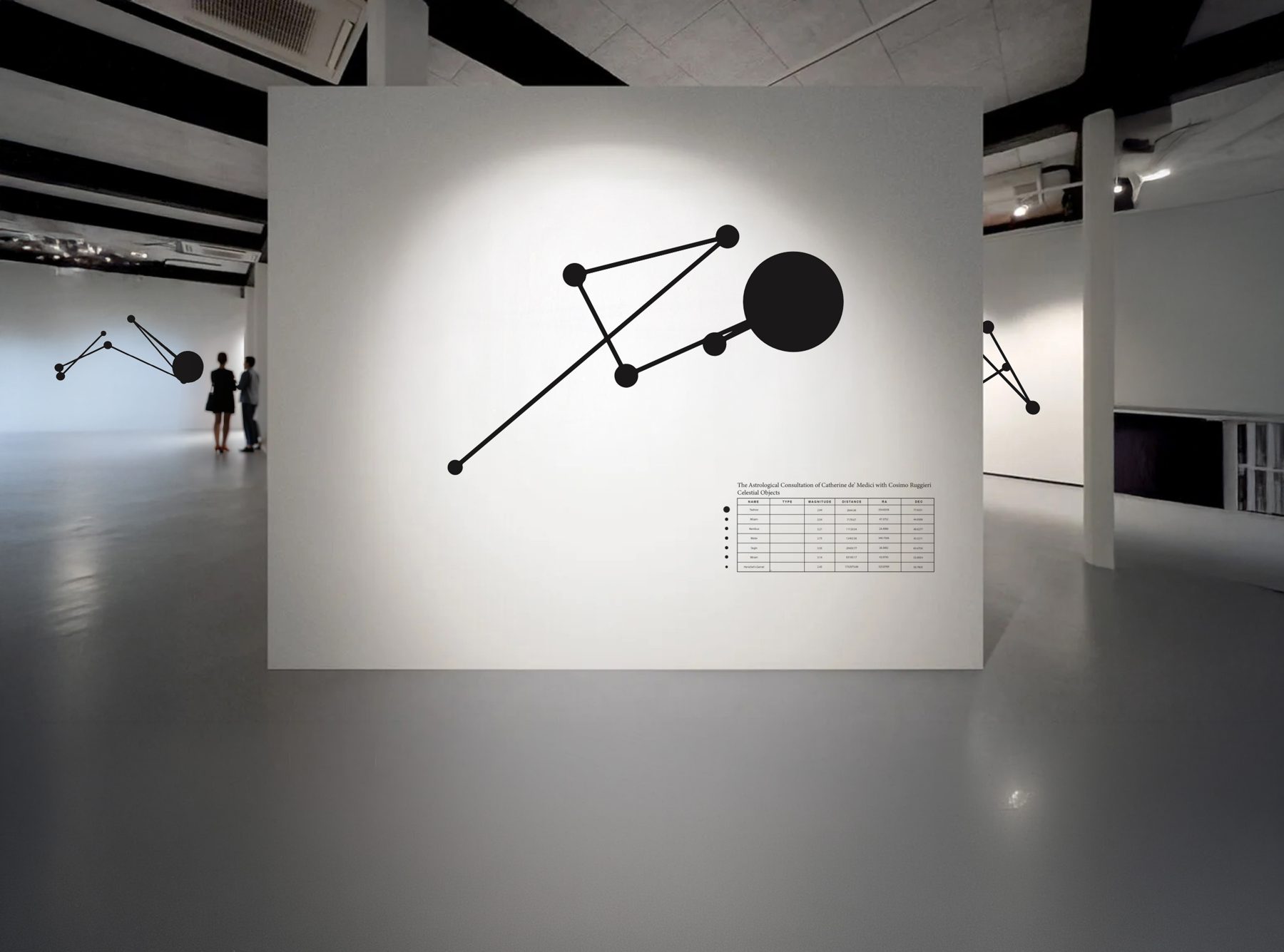
Burning Blue joins this lineage with a singular proposition: the mechanism does not reproduce the movement of the stars, it recovers a moment. Given a date, a place and a precise time, it determines the exact zenith asterism of that moment, in other words the celestial bodies that were actually above that place.
At the heart of the system, an algorithm developed by Vidya-Kélie, patent pending, draws on data from major international programmes: NASA, the European Space Agency (ESA/Gaia) and the SIMBAD astronomical database. Each work comes with a document tracing the data of that sky: nature of the celestial bodies, distance, magnitude. The artist calls it a proof-machine, in which data becomes both archive and storytelling material.
Like the orreries of the past, this mechanism relies on the most precise knowledge of its time. But its gears are now star catalogues and code.
From data to sculpture
Calculation is not the end of the work but its starting point. Vidya-Kélie moves from code to drawing, then from drawing to material. Data becomes an abstract image, and that image becomes a sculpture. Celestial bodies become discs, their links become rods. Scientific precision takes form, and form becomes story.
This is where art meets space. The Earth spins and travels its orbit, and the Sun itself crosses the Milky Way: the sky seen from one place, at one time, almost never returns as it was. The sculpture holds what will not come back.
Vidya-Kélie is now working on the form the mechanism itself will take.
The artist
A transmedia artist and graduate of the Beaux-Arts in Angers, Vidya-Kélie lives and works in Paris. For over ten years she has extended her practice into the digital through graphic design and programming. Her work is shown internationally, notably in Alexandria, London, New York, Istanbul and Tokyo. Her background and awards.
She also speaks on these questions, notably in 2024 at the round table Heavenly Bodies, Earthly Beings at the Centre Wallonie-Bruxelles in Paris, at the invitation of Manuela De Barros and Denise Thwaites, as part of an international colloquium, and in a talk on #SUN at Université Paris 8.
Notes and sources
- Antikythera mechanism: Euronews, 2026 ; Wikipedia overview. Its exact dating remains debated across sources.
- Origin of the orrery: Wikipedia overview, model by Graham and Tompion held at the History of Science Museum, Oxford (c. 1710).
- Works cited. Alexander Calder: Calder Foundation, MoMA. Attila Csörgő: Ludwig Museum, Secession, via e-flux. Katie Paterson: artist's website, Ingleby Gallery. Alicja Kwade: Whitechapel Gallery, 303 Gallery. Conrad Shawcross: Science Gallery London.
- Astronomical data: NASA, ESA/Gaia, SIMBAD database (CDS, Strasbourg).
- Vidya-Kélie: Hypercodex.org, ISEA2023 archives.
Find the sky of a moment that matters to you.
Try the mechanism on burningblue.studio